Glass By Daryl
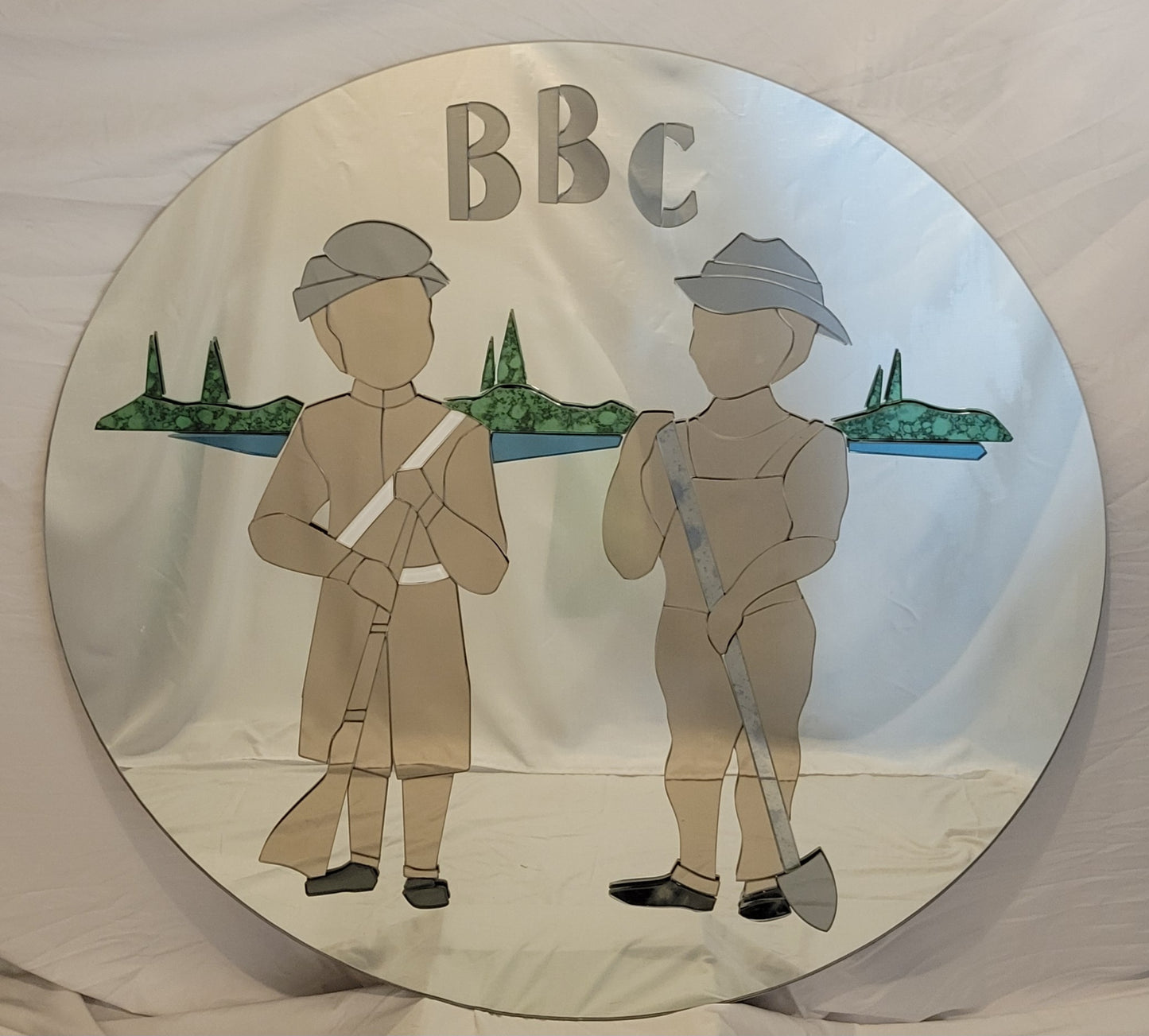
Black Brigade of Cincinnati
Black Brigade of Cincinnati
Couldn't load pickup availability
The history of the Black Brigade of Cincinnati
- Sept 1, 1862 Major Gen Lew Wallace declared martial law in Cincinnati, and had all able-bodied men of color ordered to help defend the city from the confederate troops that were anticipated to approach the shores of the Ohio river.
- 400 black men were forcibly corralled with bayonets into a mule pen at the location of 4th and Plum streets.
- Although the Gen didn’t approve of the treatment of the men, he appointed Judge William Martin Dickson to oversee the group. Dickson sent them home and asked if they would return to help with defending the city. The men would return the next day and the number of recruits swelled from 400 - to 700.
- Dickson’s aide, James Lupton gave them the name the Black Brigade and created a unit flag for them.
- The Black Brigade of Cincinnati would be the very first colored unit to be employed for military purposes during the civil war. They would precede the infamous 54th Massachusetts of which the movie Glory was presented in their honor.
- Of the 700 men who would work on digging trenches and building ramparts, only one would die, Joseph Johns, when a tree fell upon him. However, none of them would even fight in the war at the river since the confederates never made it this far. The men worked for some 18 days only to be relieved of their duties and sent home.
- Some however were determined to get in the fight. Some went on to join the 54th Massachusetts, while others would join the ranks of the 127th Ohio Infantry, later reconstituted as the 5th United States Colored Troops.
- Two of those volunteers, Powhatan Beaty a local cabinet maker would get in the fight and eventually receive the Medal of Honor. Peter Fossett a minister/caterer who would rise to the rank of Captain with the Black Brigade but would not participate as a soldier during the war.
Powhatan Beaty
October 8, 1837 – December 6, 1916
Beaty was born a slave in Oct, 1837 in Richmond, Virginia. He eventually made his way to the Ohio valley settling in Cincinnati. Being literate, he worked as a cabinetmaker and became an actor and orator. After his service in the war, he would go on to perform Shakespearean plays in theater. Performing for the likes of Frederick Douglass, at Ford's theater in Washington, DC. He would even write a play detailing the life of a slave.
During his service in the war, Beaty would rise to the rank of sergeant after only two days in. Soon after that he made the rank of first sergeant. During the battles of the Richmond - Petersburg Campaigns, Beaty fought with honors and at the battle of Chaffin's farm, Sept. 29,1864, he would go on to distinguish himself as a true patriot. Beaty’s regiment, Company G, was assigned to attack the center of the Confederate defenses at New Market Heights. The attack was met with intense fire by the enemy. The company's color bearer was killed and after retreating Beaty returned some 600 yards to retrieve the company's colors. Company G consisted of 83 enlisted men and 8 officers who entered the battle. After the first attack only Beaty and 16 enlisted men were left. With all 8 officers dead or wounded, Beaty took control and led the unit in a second attack driving the confederates from their fortified positions. He would lose 3 more men in the final skirmish and by the end of the battle over 50% of the black division were killed or captured. Beaty surviving without a scratch would be commended for his actions on the battlefield and 7 months later on April 6 ,1865 he would be awarded the Medal of Honor.
Beaty would go on to distinguish himself in battle. In 1864 he was mentioned in the general orders to the Army of the Potomac. The regimental Commander twice recommended him for promotion to Commissioned officer but nothing came of it. However, he did receive a brevet promotion to lieutenant. By the time he mustered out of the army he had fought in 13 battles and several skirmishes.
After the war he returned to Cincinnati. His son A. Lee Beaty became an Ohio State Legislator and an assistant U.S. District Attorney Beaty returned to the theater and would engage in public speaking as well as becoming a well-known elocutionist, among the African American community. (person who teaches the art of formal speaking in pronunciation, grammar, style and tone).
In January of 1881 he wrote a play about a rich southern planter entitled Delmar, or Scenes of Scotland. He would perform the lead role as it covered the end of slavery and transition to freedom for blacks from 1860 - 1875.
In January 1884 Beaty was working as an assistant engineer at the Cincinnati Water Works when a Ms. Henrietta Vinton Davis came to town to perform. Together the 2 put on a musical and dramatic festival in Melodeon Hall which was successful. Some of the performances included Ingomar the Barbarian, Robert Montgomery Birds, and the Gladiator, with Beaty playing Spartacus. The finale would be selected scenes from the play Macbeth with Beaty playing the lead and Davis playing Lady Macbeth. In May of the same year the 2 would go on to perform at the Ford’s Opera House in DC, to an audience of 1100 patrons of which Fredrick Douglass would be in attendance.
Beaty would continue to perform with Davis and in 1888 he would eventually settle down in Cincy where he helped form the city’s Literacy and Dramatic Club. he would become the organization's Drama Director. He would live out the rest of his life in Cincy until his death at age 79. He is buried at the Union Baptist Cemetery, which is located on Cleves Warsaw in Price Hill.
Peter Fossett
June 6, 1815 - January 1901
Born a slave at Monticello, the Plantation of Thomas Jefferson, Fossett was also literate. Jefferson would allow the children of his slaves to be educated with his grandchildren who were educated by Lewis Randolph, Jefferson’s grandson.
Fossett’s mother, Edith Hern Fossett, the head cook at Monticello, was trained in the art of French cuisine. His grandmother was Mary Hemmings, the older sister of the infamous mistress to Jefferson, Sally Hemmings, both of whom, were free. Fossett, a slave, did not know he was until Jeffersons death and his mother and 8 children were sold. His father Joseph, and 4 others however were freed by Jefferson per his will at the time of his death. Peter would be sold to a Col. John Jones, who was not as kind and didn’t tolerate him reading or teaching other slaves and would threaten him with cruel punishments. Eventually after 2 failed escape attempts Peter was put on the auction block again.
In 1850 at the age of 35, his father Joseph, would purchase his freedom and moved him to Cincinnati. In 1854 he would meet and marry a woman named Sarah Morant. In 1862 as the civil war approached the Ohio river valley, Peter would get pressed into service as a member of the Black Brigade. He would rise to the rank of Captain during his time with the group but would not endeavor to fight in the war.
In 1870, after his time with the Brigade, he and brother William would open a catering business, serving the social elite of Cincinnati. He joined Union Baptist Church the oldest black church in Cincinnati, est. July 14, 1831. Ordained as a minister, he would pastor there for 25 years eventually founding his own church, First Baptist Church in Cumminsville, where he would pastor in total some 32 years.
He and his wife would sire 4 children of whom 1 Martha “Mattie” E. Kelly would survive to adulthood. The two became active in their work on the underground railroad as both would become conductors. Fossett himself being praised for his efforts by the likes of Levi Coffin who was said to be the President of the UGR. Coffin a Quaker lived in Indiana in Wayne County across from Darke county in Ohio, where a lot of black settlements had been established. He died in Avondale, and is buried in Spring Grove Cemetery.
Sarah was trained by a French hairstylist in New Orleans and her owners brought her to Cincinnati, and introduce her to the wealthy elite of the region where she would become the stylist to the stars, so to speak, of her era. Her owner a miss Alice Claypoole Gwynne who would later become Mrs. Alice Claypoole Gwynne Vanderbilt of the Vanderbilt family. Sarah with the influence of her employer, became the premiere stylist to Cincinnati’s elite class.
Sarah, in history, would precede Rosa Parks, as she too would have an altercation with public transportation. In 1860 she was not allowed to board a streetcar and she sued the streetcar company and won.
Sarah and Peter served the African American community. They had their Church, helped with orphanages in Cincy, worked with the UGR, and Sarah would serve as the manager of the Colored Orphans Asylum for more than 25 years. In 1898 Peter would write a book of his memories titled, Once a Slave of Thomas Jefferson. Believing his life was about over he went back to Monticello with the help of friends. He was allowed to stay as long as he wished, claiming that place was like an earthly paradise when he was a boy. After 2 weeks, he passed away in January 1901. He is believed to be the last surviving slave from Monticello. Sarah would follow him in death in December of 1906
-
Specifications:
- Dimensions: 40" Diameter
- Weight: 50 lbs
Share